

Kjell Aleklett, Professor in Global Energy Systems at Uppsala University, Sweden.
The Swedish newspaper Svenska Dagbladet has now, 2012 December 23, published my article “EU must drastically reduce its oil imports.” In Swedish, “EU måste skära ner sin oljeimport drastiskt.” Michael Lardelli has made an excellent translation of the article, and I have added some relevant photos and graphs. Every week you are around 1000 persons that read my blog and me which you all Merry Christmas and a happy new year.
The term “Peak Oil” refers to that point in time when the rate at which oil is produced can no longer be increased and instead plateaus or begins to fall. Peak Oil does not mean that oil production is over, but it does mean that the era of increases in the rate of oil production is over. During autumn I have been invited to give presentations on Peak Oil in China, Abu Dhabi, the EU, Canada and the USA. The conferences have addressed food production, fuel use by the aviation and shipping industries, resources, reserves, and production of unconventional gas and oil as well as political policy in the light of the reality of Peak Oil. Among other things, I have had meetings to discuss Peak Oil with representatives from the oil industry, the World Bank, the International Monetary Fund (IMF), investment companies, trading banks and the aviation and shipping industries.
An important meeting occurred in Quebec with approximately 120 politicians of the International Parliamentary Union (IPU) that was established in the 1800s and represents 162 parliaments around the world. For the first time in the IPU’s history, they discussed the importance of energy for the global situation, and they chose to discuss the future from the perspective of Peak Oil.
In the review of Peak Oil produced by Professor Øystein Noreng for the Finance Department in Sweden and presented last spring (Brännpunkt, 30 March), and in some of the reports produced by members of the oil industry and think tanks during the past year there is a message that we do not need to worry about oil production. Journalists describing these reports have done so under large, bold headlines. In contrast, when one discusses Peak Oil with the people who deal with the daily reality of oil production one finds genuine concern for what Peak Oil will mean for our future because, in reality, our world is completely dependent on oil. The most critical factor determining the performance of the world economy is access to inexpensive oil.

Douglas-Westwood is a company based in New York and specializing in market research and analysis for the energy industry. At a conference in Austin, Texas at the end of November, Steven Kopits of Douglas-Westwood presented an analysis that showed the ability of various nations and regions to “carry” (tolerate) a particular oil price while still showing economic growth. In 2003 when the oil price was below $30 per barrel, the US economy was so strong that it could carry an oil price of $60 per barrel while the corresponding number for China was $50 per barrel. At the start of 2008, the economies of both nations had developed so that both could carry an oil price of $70 per barrel. It was in that year that the current shortage of oil caused the price to exceed $70 per barrel. Indeed, when the price of oil spiked to $147 in July of that year the world economy subsequently crashed. There were segments of the economy – such as the US debt market – that were affected worse than others and that contributed to the crash, but the most important initiating factor was the high price of oil.
From the beginning of the 1980s until 2003 the international oil industry was able to increase its rate of oil production by 1.5% per year, and this provided for growth in the world economy (GDP) of 3% annually. When the International Energy Agency (IEA) presented its yearly World Energy Outlook report in 2004 this coupling between growth in the rate of oil production and GDP growth was the most important factor underlying its calculations that the world would require 121 million barrels per day (Mb/d) of oil production in 2030. At around the same time, my research group Global Energy Systems at Uppsala University published an article showing that this rate of oil production was impossible to achieve in reality. We estimated that the rate of oil production in 2030 would be approximately 40 Mb/d less than the IEA had estimated the world would require. Today, the IEA has revised down its estimated rate of oil production in 2030 to 96 Mb/d, a reduction of 25 Mb/d. Thus, their estimates are now approaching those of our earlier calculations. When one studies the IEA’s latest scenario in detail, it can be seen that it still includes aspects that are not realistic (if one believes the representatives of the oil industry which whom I have spoken).
If we return to our earlier discussion and examine the oil price that the Chinese and US economies could tolerate today, Steve Kopits showed that the Chinese economy had developed so strongly that it can now carry a price of over $100 per barrel while the USA can now only carry $80. The fact that (for various reasons) the price of oil in the USA is currently approximately $20 lower than the world price of oil that China pays shows that both China and the USA are balanced on the knife edge of what they can tolerate. Without the new oil available in the USA from the production of shale oil, the US economy would have been unable to cope. Today, the rate of this production is approximately 1 Mb/d, and estimates of US shale oil production in 2020 vary between 2 and 4 Mb/d.
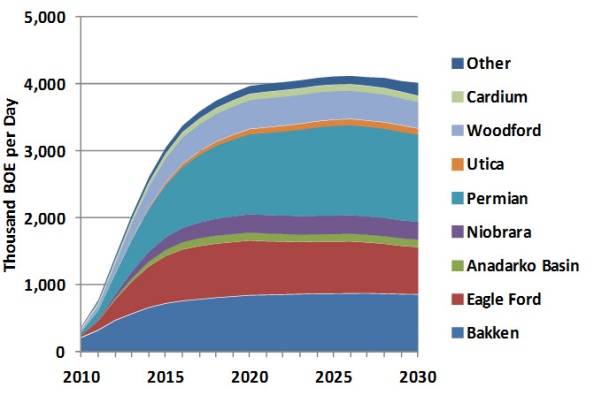
An optimistic view of future shale oil production in the USA (Hart Energy, Houston, USA). BOE is “Barrel of Oil Equivalent” because the products of shale oil production vary in their energy content and so simple comparisons of production volume are not valid.
The EU lacks production of shale oil, and so its economy must withstand a world market price of over $100 per barrel. According to some experts, the EU cannot expect significant production of shale oil in the future. The ability to pay this world oil price varies between the EU’s nations. Sweden that has export products that fluctuate in value somewhat consistently with the price of oil has been able to cope so far. However, countries such as Greece, Italy, and Spain are in a worse situation. They do not have the means to pay for the oil imports that they require without accumulating additional debt. But now the OECD is warning that even Sweden’s economy will weaken. It is time for the EU’s finance ministers to begin to discuss oil and Peak Oil. Austerity measures that reduce a nation’s government spending have only a marginal influence on its oil import needs. The fact is that the EU must drastically reduce its oil imports. Politically, the EU’s governments currently want to do this to protect the environment from climate change but the reality is that reducing oil consumption and oil imports are vital to the EU’s future economic success.
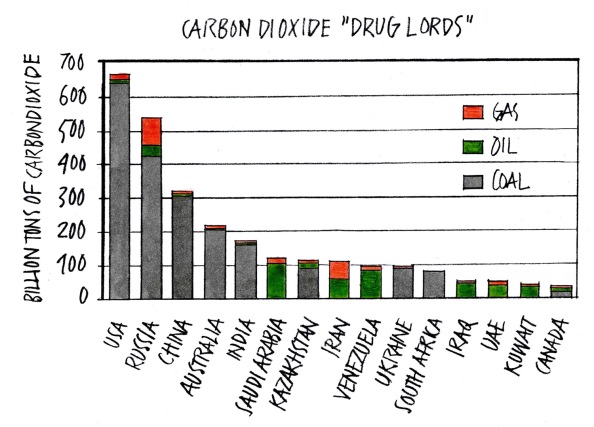
The climate change negotiations in Doha have now ended, but while they were underway, we heard representatives of the environmental movement state that we must reduce our oil consumption. Peak Oil will assist this. However, regarding carbon dioxide emissions oil has only a marginal influence compared to coal. If we accept those reserves of fossil fuels reported by BP and convert them to possible carbon dioxide emissions, then we find 350 billion tons (Gton) of possible emissions from natural gas, 540 Gton from oil and 2,300 Gton from coal. This means that 85% of possible future carbon dioxide emissions come from fossil reserves that exist in only 15 nations and it is 9 of these nations that are principally expected to use the majority of this coal. The most important action to protect the environment in future is to use less coal for electricity production. We see now that increased extraction of natural gas in the USA has meant that they are reducing their use of coal for electricity production and that carbon dioxide emissions from the USA are declining even though they have not signed the Kyoto Protocol. However, China’s enormous investment in coal-fired electricity generation means that total global emissions of carbon dioxide from coal use are increasing and it is crucial that China invests in renewable and nuclear energy sources. The fact that Germany is shutting down its nuclear electricity generation means that it will emit more carbon dioxide than necessary. The money the Germans are currently spending to replace nuclear energy would be better spent reducing coal-fired electricity generation which would reduce total carbon dioxide emissions by the EU.
When I released my book, Peeking at Peak Oil, in May the journal World Oil wrote the following, “…this book should be required reading for anyone seriously interested in the future world energy market and economy, especially politicians and policymakers.” In this article, I have discussed how the economy is influenced by Peak Oil, but there are many other areas that will be affected. Ten years ago I wrote that we would see problems in a decade. The IEA estimated that we would require a rate of oil production of 93 Mb/d while we stated that only 85 Mb/d was possible and, in reality, we now see that only 83 Mb/d was achieved. Our daily lives could have been better now if decision-makers had paid attention to our calculations.
Read more: https://aleklett.wordpress.com/2012/12/23/eu-must-drastically-reduce-its-oil-imports/